Dental Clinic Cleaning
Dental rooms collect what other clinical rooms do not. Every handpiece throws a fine mist that settles on cabinetry, screens, skirting and the top of the light arm, and it lands whether or not anyone can see it. Dental clinic cleaning has to reach those surfaces nightly while staying well clear of everything your assistants reprocess. That split is the whole job, and it is written into the scope. This service sits within our medical cleaning services.
What does dental clinic cleaning include?
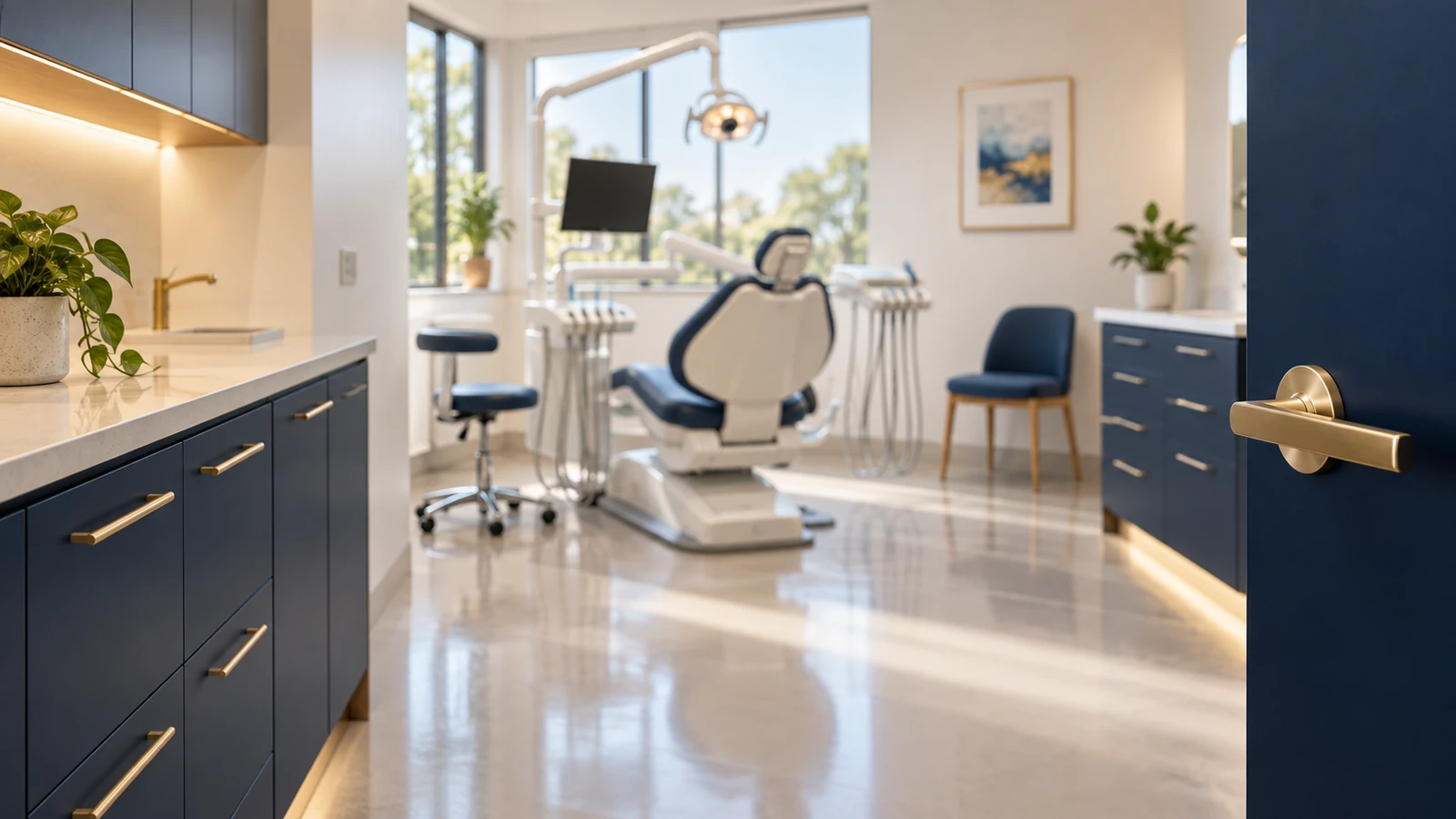
Surgery floors, cabinetry exteriors, benches your team has cleared, the chair base and arms, light arms, door furniture, waiting and reception, bathrooms, the staff room, and the floor and bench fronts of the sterilising room.
A dental practice is a small building with a big cleaning problem. Four surgeries, a sterilising room, a reception and two bathrooms can fit into 150 square metres, and every one of those surgeries produces aerosol for eight hours a day.
The work splits cleanly. Everything that supports treatment is ours: the room itself, its surfaces and the fabric around the chair. Everything used in treatment or reprocessed afterwards belongs to your dental assistants, who are trained for it and accountable for it.
| Area | Every visit | On rotation |
|---|---|---|
| Surgeries | Floors, chair base and arms, cabinetry fronts, light arm, bin, door furniture | Skirting, cabinet tops, wall marks, vents |
| Sterilising room | Floor, bench fronts, handles, bin | Under-bench floor, shelving fronts |
| Reception and waiting | Counter, terminal, chairs, glass, floors | Upholstery, high dusting, entry matting |
| Bathrooms | Pan, basin, taps, dispensers, floor, restock | Descale, grout, exhaust vent face |
| Staff room | Benches, sink, fridge handle, table, floor | Inside microwave, cupboard fronts |
Why does aerosol settle change the cleaning routine?
Because it lands everywhere, not just where you look. Fine spray from handpieces and scalers drifts across the room and settles on high and low surfaces alike, so the routine has to cover cabinet tops, skirting and light arms rather than only the bench in front of the chair.
In a general practice, soil arrives where hands go. In a dental surgery it arrives on air. That single difference is why a cleaner used to medical centres will underperform in a dental room on the first night, and why the task list has to be written differently.
The practical version is a height cycle. Every visit covers working height and floor level, where most of the settle lands. On rotation, the crew goes higher and lower than that: the tops of cabinets, the upper third of the light arm, the trim above the door, the skirting behind the chair and the floor under the cabinet lip.
Screens and monitors get their own product. Dental rooms often have a screen at chairside for images, and it collects the same mist as everything else while being the surface most easily damaged by the wrong spray.
- Working heightBenches, cabinet fronts, chair arms and the light arm, every visit.
- Floor levelVinyl mopped to the edges, including under the chair base and cabinet lip.
- High and lowCabinet tops, door trim, skirting and vent faces, on a written rotation.
How are chairside and surgery surrounds cleaned?
After your assistant has removed barriers and cleared the bracket table, we clean the fabric of the room: the chair base and upholstery where the manufacturer allows it, the stool, the bench face, the sink surround, the bin and the floor. The delivery unit and anything clinical stays untouched.
Product compatibility decides half of this. Dental upholstery and cabinetry finishes are specified by the manufacturer, and the wrong disinfectant will craze vinyl or dull a laminate within weeks. Before the first clean we check the fit-out documents or the manufacturer's cleaning instructions and match the products to them, then record that choice on the product register.
Where a surface is not on the approved list, we do not improvise. It goes on the exclusions list with a note explaining why, and your team keeps it.
Suction lines, spittoons and traps are a common source of confusion. Those are flushed and maintained by your staff on the practice's own schedule, because they are part of the treatment equipment rather than the room.
Floors in a dental surgery carry more than dust. Composite dust, cement and the occasional drop of impression material all set hard, so the routine includes checking for and removing residue rather than mopping over it.
What happens in reception, waiting and bathrooms?
They get the first pass of the night, while cloths are fresh: counter and card terminal, chairs and arms, glass, children's corner, then bathrooms with the red kit at the end of the visit and full restocking before the crew leaves.
Dental patients arrive anxious and leave numb, and the waiting room absorbs both. It sees high turnover in short appointments, children waiting with parents, and people handling brochures and toys while they wait.
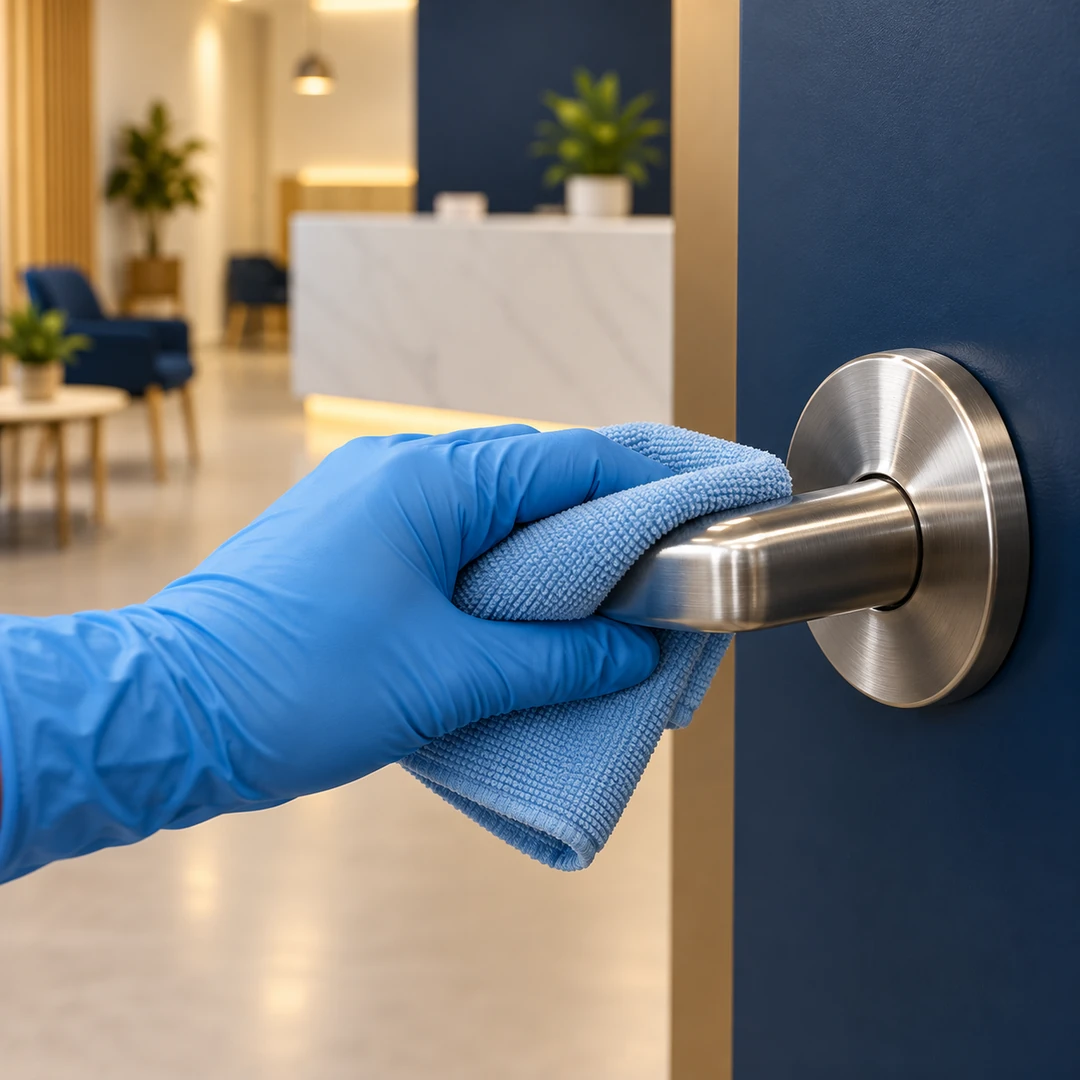
So the front of house gets the same touchpoint treatment as a medical waiting room, with two additions. Brochure racks and product displays are wiped rather than dusted around, since practices selling whitening kits or brushes have retail stock people pick up. And glass gets attention at child height, where it is marked most and noticed least.
Bathrooms are done last with the red kit. In small practices the same bathroom serves patients and staff, which makes restocking more visible: one missing hand towel roll in a dental practice is noticed by everyone in the building within an hour.
Where does the reprocessing boundary sit?
Entirely with your practice. Instruments, handpieces, ultrasonic baths, washer disinfectors and the steriliser are reprocessed by trained dental staff under the practice's own protocol. Our crew cleans the room those machines sit in, and nothing that goes through them.
Ours, once the room is cleared
- Sterilising room floor, including under the bench lip
- The outside faces of benches, cabinetry and drawer fronts
- Door furniture, light switches and the general waste bin
- Sink surrounds and splash zones, once staff have finished
Always your team's
- Instruments, cassettes, handpieces and burs
- The steriliser, its trays, its chamber and its records
- Ultrasonic baths, washer disinfectors and their cycles
- Barrier removal, suction lines, traps and clinical waste
Reprocessing in Australia is governed by its own standard, AS 5369:2023, which Standards Australia explains in its overview of the reprocessing standard. It replaced the earlier standards for both health services and office-based practice, and it is written for clinical staff rather than cleaners.
Practitioners also work under the Dental Board of Australia's codes and guidelines. None of that is our responsibility, which is exactly the point: a cleaning contractor should not be anywhere near the parts of your practice that are regulated professionally.
What does dental practice cleaning cost?
Chair count sets the base, then the number of visits a week, then the finishes. A four-surgery practice on five nights pays more each month and less each visit than the same practice on two, and a hard-floor fit-out prices differently to a carpeted reception.
Surgeries are the unit of measure in dental work, not square metres. Each one is a small clinical room with a fixed task list, and the time per surgery barely moves once the routine is set.
Frequency is the bigger lever. Most practices run daily, because aerosol settle does not wait for Thursday. Part-time practices with two or three clinical days often clean on those days only, which works as long as the rotation still happens.
Two things add time that owners rarely predict. Older vinyl with failing sealer needs machine work to look presentable, and it needs stripping and resealing before any nightly routine can fix it. And practices with a separate ortho or hygiene room often forget to include it when they count chairs.
Quarterly deep cleans are common in dental work because of the settle. Those run as an infection-control deep cleaning visit and are priced separately. The arithmetic behind a per-visit figure is laid out on our page covering medical cleaning cost.
How do we price a dental practice?
Tell us the number of surgeries, your finishing times and whether the fit-out is new or older. We walk the practice after hours with your practice manager, check the finishes against product requirements, and send a fixed per-visit price the next working day.
Bring a senior dental assistant to the walk-through if you can. They know what gets cleared each night, which surfaces the manufacturer restricts, and where the practice has had trouble before.
We also ask about your busiest sessions. Practices running late on Tuesdays and Thursdays usually need a later start on those nights, which is easier to build in at the start than to renegotiate.
Practices on a fixed nightly roster keep the same crew on the same nights, which is described under after-hours medical cleaning programs. The method behind all of it is covered on our main page for medical cleaning in Melbourne.
When you are set, get a quote with your surgery count and finishing times.
What do dental practices ask us first?
Whether we touch the chair or the instruments, what we do in the sterilising room, and how late we can start. Short answers here, and all three are written into the scope before any crew attends.
Do you touch instruments or the chair?
Never instruments. The chair is cleaned only on its non-clinical parts, meaning the base, arms and upholstery, and only with products the manufacturer allows for that model. Handpieces, the delivery unit, suction lines and anything reprocessed remain with your dental assistants at all times.
Do you clean the steri room?
We clean the room, not the equipment. Once staff have finished for the day and the bench is clear, the floor, bench faces, cabinetry fronts, handles and general waste bin are cleaned. The steriliser, ultrasonic bath, washer disinfector, trays and cycle records are untouched.
Can you come after our last patient?
Yes, that is the normal arrangement. Crews arrive once the surgery list has finished and your assistants have closed the rooms down. Practices running evening appointments can have later starts on those nights, and Saturday clinics can be scheduled on the same basis.
Dental practice needing a cleaner who knows the line?
Tell us how many surgeries you run and when the last patient leaves. We will do the rest in writing.