Day Surgery and Procedure Facility Cleaning
Licensed day procedure centres do not buy cleaning the way a practice does. They buy a documented system that an assessor can follow, delivered by crews who have been inducted into the facility and who understand where their work stops. Day surgery cleaning at that level means recovery bays, pre-admission and consult areas, corridors and front of house, with theatre work scoped strictly against your own protocol. This service sits inside our medical cleaning services.
What does day surgery cleaning have to satisfy?
Four things: a written schedule tied to your own infection prevention policy, crews trained and inducted for the facility, products and contact times recorded per area, and documentation an assessor can read without help from us.
Day procedure services answer to the NSQHS Standards, where environmental cleaning sits under the Preventing and Controlling Infections Standard. The facility owns that obligation. A contractor supports it, and the support is only useful if it is written down as it happens.
That changes what a cleaning contract looks like. Instead of a task list, the facility gets a schedule mapped to areas, a competency record per crew member, product details with contact times, and a log per attendance that can be pulled at any point in an audit cycle.
| Requirement | What it looks like in practice | Who holds it |
|---|---|---|
| Area schedule | Every area named as the facility names it, with frequency and method | Facility policy, our delivery |
| Competency records | Training and induction logged per crew member attending the site | Us, produced on request |
| Product control | Listed products, data sheets on site, contact times recorded by area | Us, approved by your lead |
| Attendance evidence | Signed log per visit, monthly summary, exceptions noted with actions | Us, filed by you |
| Escalation path | Named supervisor and account contact, with response times agreed | Both, in the contract |
Facilities differ on where a contractor may go, and that difference is legitimate. One centre lets cleaning staff into the dirty utility room under supervision; another does not allow it at all. Neither is wrong, and both need the answer written down before a crew starts rather than resolved by a cleaner at eleven at night.
The same applies to timing. Some centres want cleaning finished before the first admission at six, others run evening lists and want the main clean at nine. The schedule follows the facility, and the crew roster follows the schedule.
- Written scheduleEvery area, its frequency and its method, aligned to the facility's own policy rather than to ours.
- Competency recordsWho has been trained, on what, and when, held for each crew member who attends the site.
- Product controlListed products only, with data sheets on site and contact times recorded against the areas they are used in.
- Attendance logsSigned per visit, kept on site, summarised monthly, and available in the format your quality manager prefers.
Which areas do we take on in a day procedure centre?
Recovery bays, pre-admission and consult rooms, corridors and waiting areas, change rooms, staff amenities and storage. Theatre work is only ever taken on where the facility asks for it and defines it, and even then it is limited to surrounds outside the sterile field.
Recovery bays
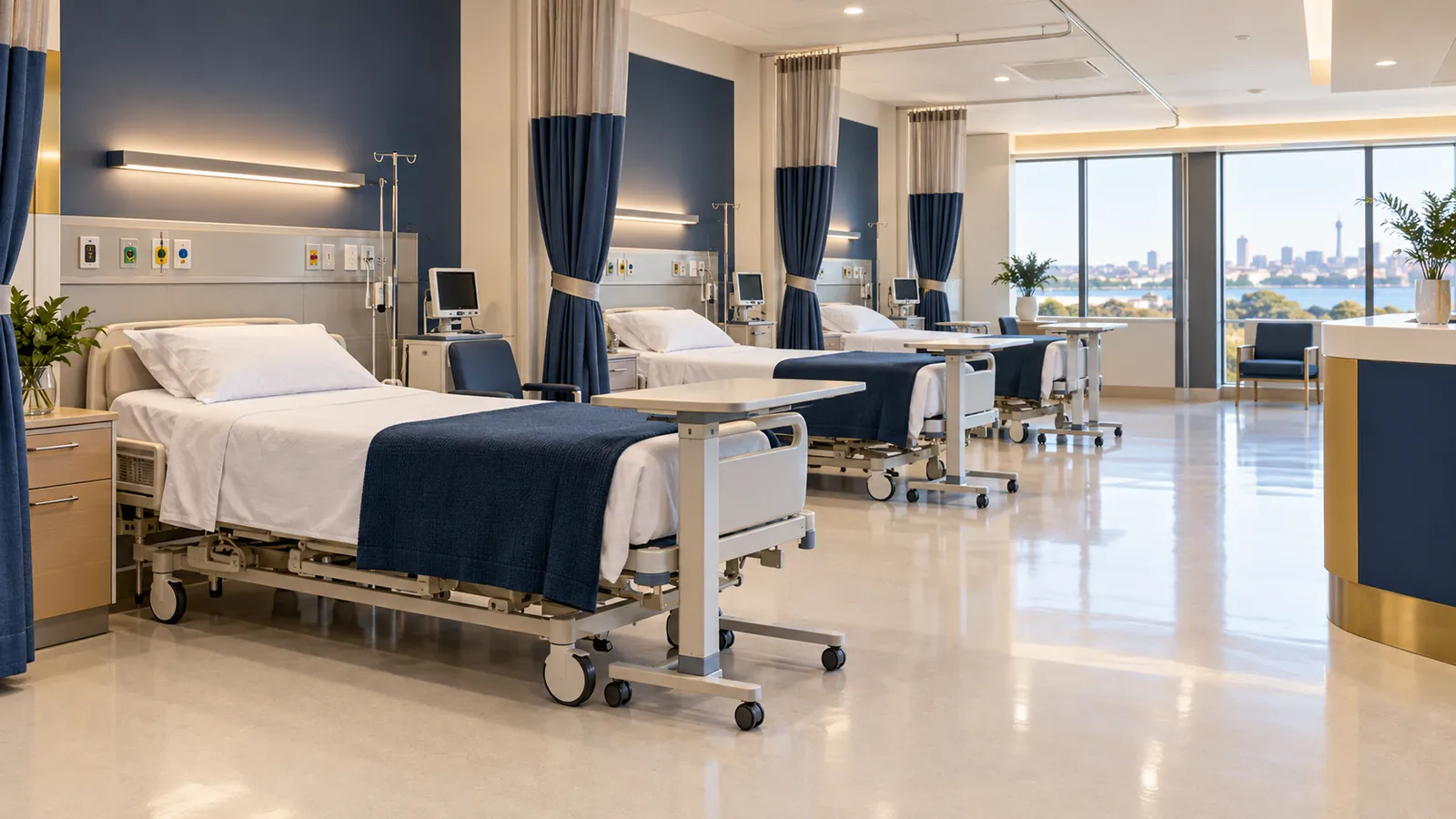
Bed or chair surrounds, side tables, call points, curtain tracks and leading edges, bin bodies, and floors under and between bays. Reset ready for the next list.
Pre-admission and consult
Assessment rooms, couches, desks, basins, weighing areas and the seating patients use while they wait to be called through.
Corridors and front of house
Reception, waiting, public toilets, lifts where the facility holds them, and the corridor runs that carry trolleys between areas.
Staff and support areas
Change rooms, lockers, staff room, offices and clean storage. Dirty utility areas only where your protocol allows a contractor in.
Recovery is where most of the time goes. A bay is really a miniature clinical room: bed or chair, monitor stand, side table, bin and curtain, and turning over eight of them properly takes longer than a waiting room four times the size.
Change rooms are the area facilities most often leave out of a tender and most often complain about later. Lockers, benches, showers where they exist and the floor under everything need a fixed frequency, because staff notice immediately when they are skipped.
Where a facility wants periodic work beyond the daily schedule, such as after building works or a flooding event, that is quoted separately as an infection-control deep cleaning attendance, with scope, chemistry and running order signed off by your infection prevention lead first.
Where does the sterile-field boundary sit?
Outside it, always. Between-case theatre cleaning, sterile field preparation, instrument handling and reprocessing are performed by your own trained staff. We do not enter that work, and we will not quote for it however the request is framed.
We would rather lose a tender than blur this. A contractor who agrees to everything in a sales meeting is a risk to an accredited facility, because the gap between what was promised and what the crew can actually do shows up during a list rather than during a quote.
If your centre wants theatres included, say so at the first meeting. It changes training, insurance, staffing and price, and it needs your nurse unit manager to write the protocol we would be trained into. That is a project, not a line item.
What documentation do auditors actually accept?
Records that show a system rather than an intention: the schedule, the competency register, product details with contact times, signed attendance logs, and a corrective action note whenever something was missed and put right.

The test an assessor applies is simple. Pick an area, pick a date, and ask what happened. A folder that answers that in under a minute passes. A folder that needs a phone call to a contractor does not.
So the pack is built around retrieval. Areas are named the way your facility names them, not the way a cleaning company would. Dates are consistent. Signatures are legible. Exceptions are recorded with what was done afterwards, because a log with no exceptions in twelve months reads as a log nobody filled in.
Quality managers usually want one more thing: a contact who answers. Each facility has a named supervisor and a named account contact, and both appear on the front of the folder.
Audit cycles also mean surge work. Before an accreditation visit, centres often want a documented deep clean of specific areas with photographs attached to the record. That is arranged as a scheduled attendance with its own scope sheet rather than absorbed quietly into a nightly visit.
The wider pack, including how missed tasks are escalated, is described on the page written for practice managers.
Why do generic contractors get rejected by day surgeries?
Usually for paperwork rather than cleaning. No competency records, no product register, no schedule mapped to areas, logs that cannot be produced on request, and a scope that claims theatre work the crew has never been trained to do.
The second reason is turnover. Facilities want to know who is in the building at ten at night, and a contractor who sends different people each week cannot answer that. Named crews, inducted and screened, matter more here than anywhere else we work.
A fifth, quieter reason is language. Tenders written in cleaning-industry phrasing rather than clinical phrasing signal that the contractor has never worked in an accredited environment, and quality managers read that immediately.
The fourth is chemical control. Facilities expect to approve what comes into the building, and a contractor who swaps products for whatever is cheapest that month will fail an audit even if the cleaning itself is fine. Our product register is fixed at the start and changed only with your lead's agreement.
The third is over-promising. A tender that says yes to theatres, yes to instrument areas and yes to waste handling will be marked down by any quality manager who knows what those things involve, because the answers reveal that the contractor does not.
How do we scope and price a day procedure centre?
In two stages. First a scoping meeting with your nurse unit manager and quality lead to agree the split, the documentation and the training required. Then a walk-through and a written price against that agreed scope, never before it.
Stage one usually takes an hour and produces a one-page split: our areas, your areas, and the grey ones resolved. Facilities that have been let down before tend to arrive with their own list, which makes the meeting shorter.
Stage two covers the practical detail: list patterns, access after hours, storage for equipment, waste routes and where crews change.
Facilities with more than one site usually run a pilot at the smaller one first. We prefer that too, because the documentation model is easier to tune on a single site than across three at once.
Pricing follows the same structure as the rest of our work, explained under medical cleaning cost, with the documentation and training load priced openly rather than buried in an hourly rate.
To start that conversation, get a quote with your facility type and list pattern, or read how we work across medical cleaning in Melbourne first.
What do day surgery managers ask us?
Whether we clean theatres, whether crews are trained for accredited environments, and whether our documentation survives an audit. The answers are below and all three are settled in the scoping meeting before any price is quoted.
Do you clean operating theatres?
Not by default. Between-case cleaning and anything involving the sterile field stays with your own staff. Where a facility wants end-of-list theatre surrounds included, it has to be defined in your protocol and our crews trained into it first, which is agreed at scoping rather than assumed.
Are your staff trained for accredited facilities?
Crews attending a day procedure centre are inducted into that facility and trained against its written protocol, with a competency record held per person. We also confirm worker screening requirements with the centre before anyone attends, because they vary between facilities.
Can you provide audit documentation?
Yes. You receive the area schedule, competency records, the product register with contact times, signed attendance logs and monthly summaries including exceptions. The format is agreed with your quality manager so it drops into your existing evidence structure rather than sitting beside it.
Running a day procedure centre?
Start with a scoping meeting. We will bring the documentation model and leave with a split everyone signs.