
Aged Care and NDIS Facility Cleaning
These buildings are homes before they are facilities. Somebody lives in the room being cleaned, eats in the dining room being mopped, and watches the crew work. Aged care cleaning in Melbourne has to feel domestic and run on clinical method at the same time, with the same faces each week and records a provider can produce at audit. It is one of the facility services inside our medical cleaning services.
What makes aged care cleaning different from a clinic?
People are present the whole time. A clinic empties at six and the crew works freely; a residential facility never empties, so the schedule follows meals, medication rounds and rest periods, and the manner of the crew matters as much as the method.
In a medical practice, the measure of a good clean is what the surfaces look like at eight the next morning. In residential care, the measure includes whether Mrs Papadopoulos in room 14 felt comfortable while it happened.
That changes practical things. Vacuuming does not start at seven in a corridor of bedrooms. Wet floor signs go up and come down quickly, because a walking frame and a wet floor are a genuine risk rather than a paperwork item. Trolleys do not block corridors that residents use to reach the dining room.
- TimingWork planned around meal services, medication rounds and afternoon rest, agreed with the facility manager.
- NoiseMachines used in common areas at agreed times, never outside bedrooms early or late.
- MovementCorridors kept clear, equipment parked out of walking lines, signage removed as soon as floors dry.
- MannerCrews greet residents, explain what they are doing and step back when someone wants to pass.
How are common areas and dining rooms handled?
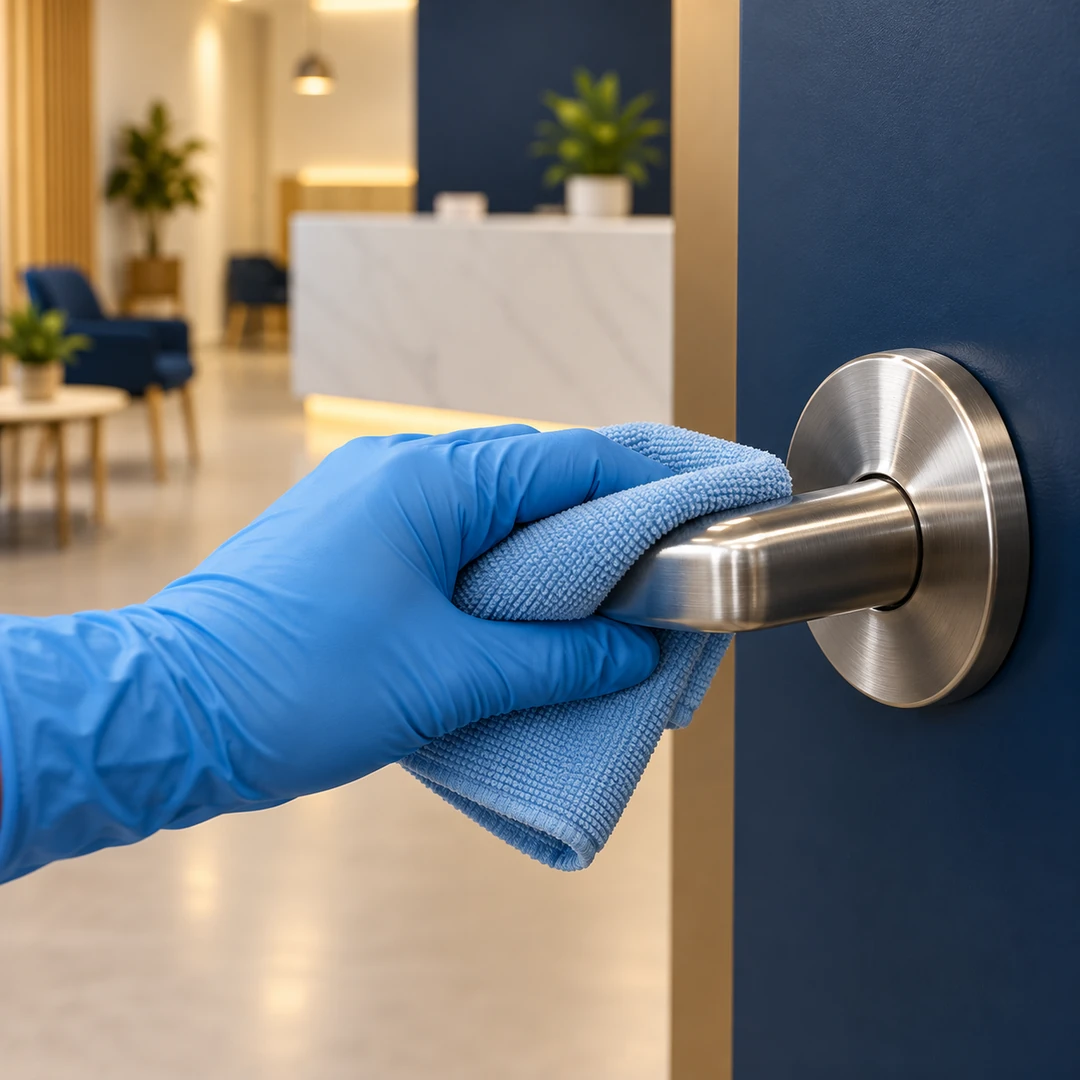
As the highest-traffic clinical-adjacent spaces in the building. Handrails, door furniture, lift buttons, chair arms, dining tables and the backs of chairs are wiped on every visit, and dining rooms are turned around between services rather than once a day.
Handrails are the single most important surface in an aged care building. Every resident who walks uses them, many with hands that have just been somewhere else, and they run the length of every corridor. They go on the fixed list, cleaned end to end rather than in the sections that look marked.
Dining rooms work on a service rhythm. Tables and chair backs are cleaned after each sitting, floors are done once the room clears, and spills are dealt with immediately rather than left for the scheduled visit, which means the crew and the facility need a shared understanding of who covers what during the day.
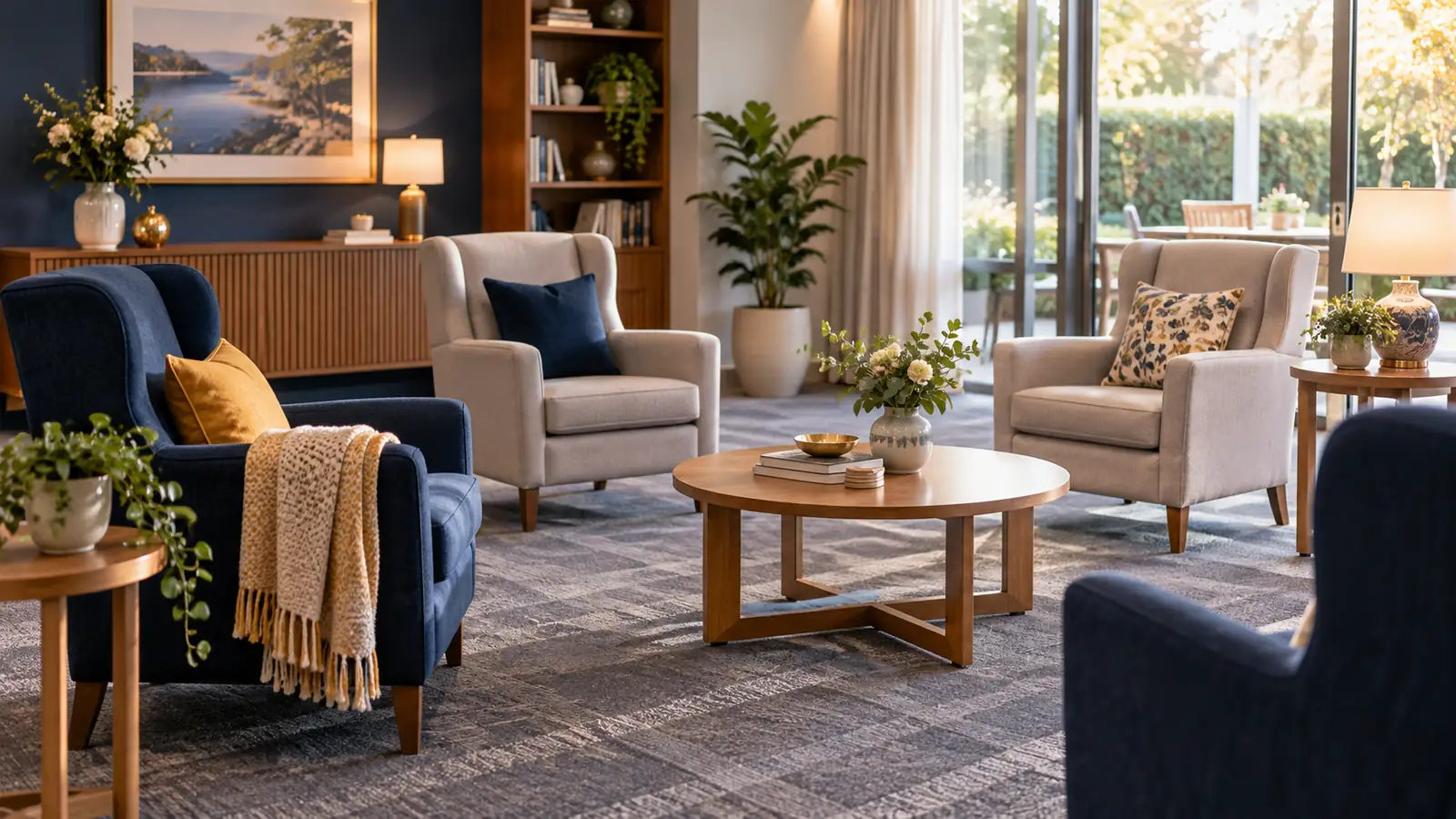
Lounges bring soft furnishings, and those need an honest conversation. Fabric chairs in a lounge used all day cannot be sanitised like vinyl. They are vacuumed, spot cleaned, and steam cleaned on a cycle, and when a chair is beyond that we say so rather than keep cleaning it.
Corridors
Handrails full length, door furniture, light switches, skirting and floors kept dry and clear.
Dining
Tables, chair backs and arms, servery surrounds, floors after each sitting.
Lounges
Seating, side tables, remote controls, activity tables and the floor beneath furniture.
How do you clean a room somebody lives in?
By asking first, working to the facility's program, and treating the room as private property. Floors, ensuite, high-touch surfaces and bins are cleaned. Personal belongings are not moved, drawers are not opened, and nothing is thrown out without staff saying so.
Resident rooms are the part of the job that separates a facility cleaner from a commercial one. The work itself is ordinary: bed surrounds, over-bed table, call bell, light switches, door handles, ensuite, floor and bin. The judgement is not.
Crews knock, wait, and explain. If the resident would rather the room were done later, it is done later and the log records why. If a resident is unwell or a family visit is happening, the room is skipped and the facility is told, rather than a cleaner pushing through an awkward moment because it was on the run sheet.
Ensuites get the red kit and full restocking. In a facility, an empty soap dispenser in a resident ensuite is not a minor issue, because the person using it may not be able to fetch more.
Belongings stay where they are. Photographs, cards, knitting, medication on the side table, all of it is cleaned around rather than moved. A surface that cannot be cleaned without moving something personal is left and noted, and staff handle it.
What about treatment rooms inside the facility?
They run on the same clinical method we use in a medical practice: yellow zone, listed disinfectant, full contact time, mapped touchpoints. Medication rooms, treatment rooms and the nurse station are cleaned to that standard, with clinical waste and medication storage left to staff.
Most residential facilities have a small clinical core: a treatment room, a medication room, a nurse station and a dirty utility area. Those rooms are where the domestic feel stops and the clinical method starts.
Medication rooms are cleaned with staff present or after they have secured the room, depending on the facility's policy. Cupboards, fridges and anything holding medication are not opened at any point.
Linen handling is worth settling early. Some facilities want cleaning crews to strip and remake beds, others keep that entirely with care staff because it sits alongside personal care. We do it only where the provider asks and trains for it.
Dirty utility rooms vary by provider. Some want contractors in there with a defined method, others keep it entirely with care staff. Whichever it is, it gets written into the scope rather than assumed.
Sluice and pan rooms follow the same logic as dirty utility. Where the provider allows a contractor in, the method is written out step by step, and where it does not, the room is simply outside the scope and nobody is guessing at eleven at night.
Where a facility has an outbreak protocol, our crews follow the facility's version of it, including any changes to cleaning order, products and personal protective equipment. Additional attendances during an outbreak are arranged as infection-control deep cleaning visits with a scope written for that event.
What screening and records do providers need from us?
Worker screening before anybody attends, and records that fit the provider's own evidence system: the area schedule, attendance logs, product register, incident notes and a monthly summary. We support your evidence. We do not certify anything.
Before a crew attends
- NDIS worker screening clearance where the site requires it
- Current national police check for every crew member
- Facility induction, including emergency and evacuation procedures
- Confirmation of any immunisation requirements the provider sets
What the provider receives
- Area schedule matched to the facility's own naming
- Signed attendance log kept on site
- Product register with safety data sheets
- Monthly summary including anything missed and the action taken
Residential aged care providers are assessed by the Aged Care Quality and Safety Commission against the Aged Care Quality Standards, which include the environment residents live in. The obligation is the provider's; our job is to hand over evidence that supports it.
For disability services, the NDIS Quality and Safeguards Commission sets out worker screening requirements, which are checked through state screening units. We confirm what your site requires before rostering anybody to it.
What drives the cost of a facility program?
Bed or place count sets the base, then the share of the building that is common area, then how resident rooms are handled. Daily coverage across long hours costs more than a single night visit, and most facilities need the longer pattern.
| Driver | Why it matters | Effect on the program |
|---|---|---|
| Places and rooms | Each room carries an ensuite and a fixed task list | Sets the base hours per day |
| Common area share | Corridors, lounges and dining need repeat attention | Often more hours than the rooms |
| Hours of coverage | Day presence for spills and dining turnarounds | Split shifts rather than one night visit |
| Soft furnishings | Vacuum, spot clean and periodic steam work | Adds a scheduled cycle |
| Outbreak readiness | Extra attendances with a different method | Priced as called on, not bundled |
The way a per-visit figure is put together, and how frequency changes it, is explained on our page covering medical cleaning cost. Facilities running fixed rosters across seven days usually structure it as one of our after-hours medical cleaning programs with day coverage added.
How is a facility program set up?
We meet your facility manager, walk the building during a normal day rather than after hours, agree the split with care staff, confirm screening requirements, then quote the program with hours mapped against the daily rhythm.
Walking a facility during the day is deliberate. An empty building at nine at night tells you nothing about where residents gather, which corridors are busy after lunch, or how the dining room turns around.
Expect the walk to take longer than in a clinic. A 90-place facility has corridors, lounges, two dining rooms, a hairdressing room, an activities space and back of house, and each of those carries its own frequency.
We also ask what the last contractor got wrong, because in residential care the complaint is rarely about cleaning standards. It is usually about noise, timing, or somebody moving a resident's belongings.
The wider method, including zones, products and records, is set out on our page for medical cleaning in Melbourne, and the records pack is described for practice managers.
To start, get a quote with your place count, the areas you want covered and any screening requirements your provider applies.
What do facility managers ask first?
Worker checks, resident rooms and audit records. Those three decide whether a contractor is usable in residential care, and each is resolved in writing before anyone is rostered on.
Do your cleaners hold NDIS worker checks?
Crews rostered to NDIS-funded sites hold worker screening clearances, and police checks are current for everyone on the roster. We confirm what your site requires in writing before anybody attends, since requirements differ between residential aged care and disability services.
Can you clean occupied resident rooms?
Yes, to the facility's program and with the resident's agreement on the day. Crews knock, explain and come back later if it is not a good time. Belongings are never moved, drawers stay closed, and anything skipped is recorded so care staff know where things stand.
Do your records satisfy audits?
They support your evidence rather than replace it. You receive the area schedule, signed attendance logs, the product register with data sheets and a monthly summary with exceptions. Providers use those in their own quality systems, and no cleaning contractor can guarantee an audit outcome.
Residential facility needing a steadier program?
Tell us the place count and the hours you need covered. We will walk it during the day and quote the rhythm.